BusinessClient projectArchive project · 2024
Expert request routerConsultation requests find an available expert on their own
A network of experts took requests in chats, and they were spread unevenly: some got many, some none, and clients waited for an answer. It needed a bot that hands out requests fairly, taking language into account, and an admin panel that shows each expert's work.
- bot languages: kk and ru
- 2bot languages: kk and ru
- message templates in the admin
- 26message templates in the admin
- expert rating scale after a sale
- 1–10expert rating scale after a sale
What we built
- Client registration in the bot: language, name and phone via a button
- Auto-assignment: an expert with the right language who has waited longest for a lead
- A lead card for the expert: accept or decline, statuses via buttons
- The client rates the expert from 1 to 10 after the deal
- A drag-and-drop lead kanban with a history for every client
- 26 message templates in two languages and broadcasts with photos, audio and video
Stack
- Python
- aiogram 3
- FastAPI
- PostgreSQL
- React
Requests are distributed in turn and by language, and the head of the network sees every expert's conversion and ratings in one report.
Questions
Expert request router in brief
Who built the product, what it does and how to order something similar.
Who built Expert request router?
Expert request router was designed and built by 105, a Kazakhstan IT company ("105kz" LLP, Almaty, Astana Hub resident) for the project owner.
What does Expert request router do?
Consultation requests find an available expert on their own. Key features: client registration in the bot: language, name and phone via a button; auto-assignment: an expert with the right language who has waited longest for a lead; A lead card for the expert: accept or decline, statuses via buttons; the client rates the expert from 1 to 10 after the deal.
Can we order a similar system for our company?
Yes. 105 builds ERP, management accounting and CRM systems around a specific business: a 1–2 week problem review, a clickable prototype in 2–4 weeks, then iterative development. Source code and documentation stay with the customer. Contact: info@105.kz, +7 (771) 803-44-47.
Cases
More in this direction
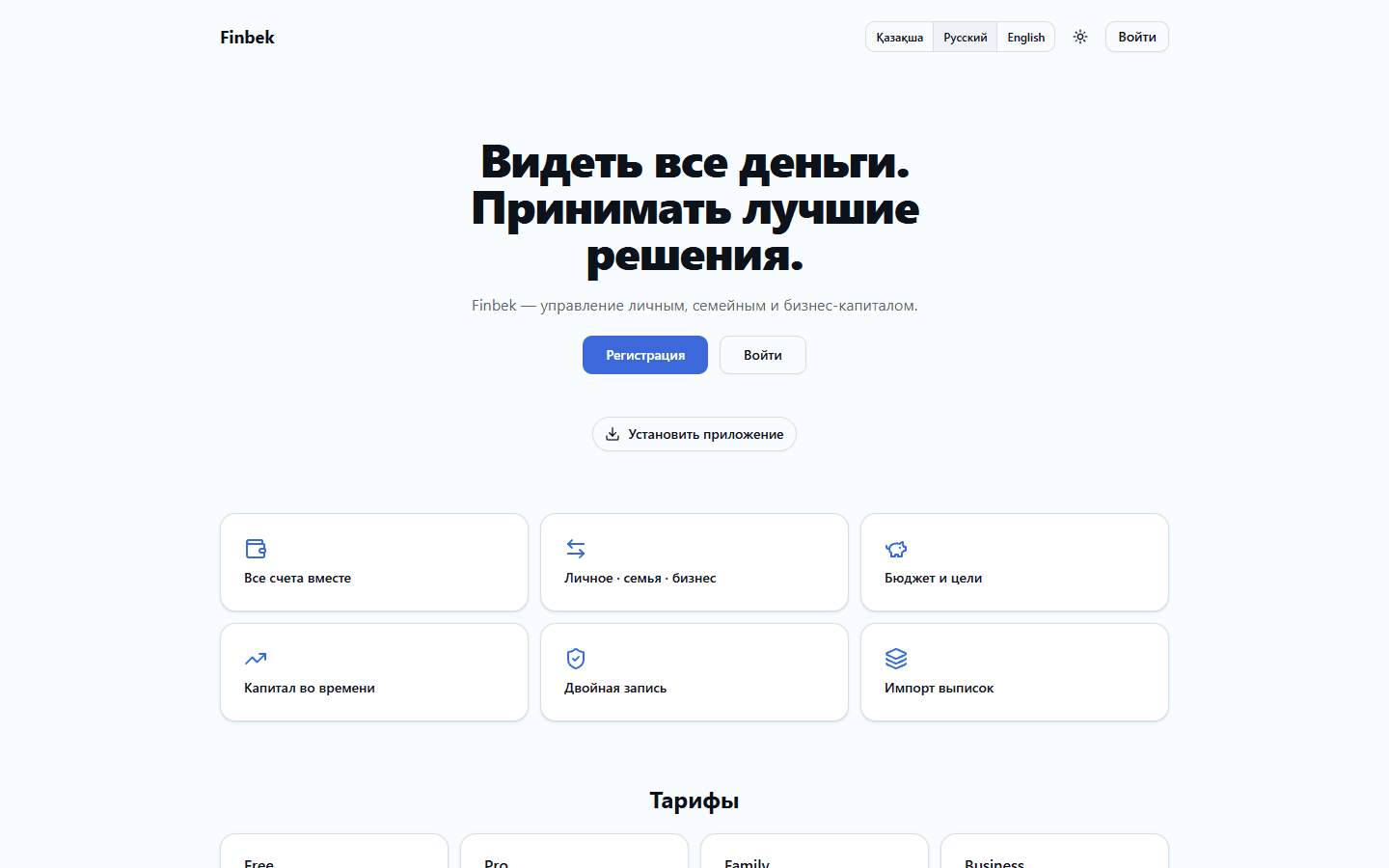
Finbek
Finbek is 105's SaaS for personal, family and business money on double-entry accounting. Accounts, plan-vs-actual budgets, goals, investments and debts live in one place; profit withdrawals, paying yourself and loans to the business are booked as paired operations that always balance. A 90-day liquidity forecast shows the date of a cash gap in advance, recurring payments post themselves and sign-in runs through the single 105 account. The interface is in Kazakh, Russian and English, with Free, Pro, Family and Business plans.
- Double-entry ledger
- 90-day forecast
- Personal · family · business
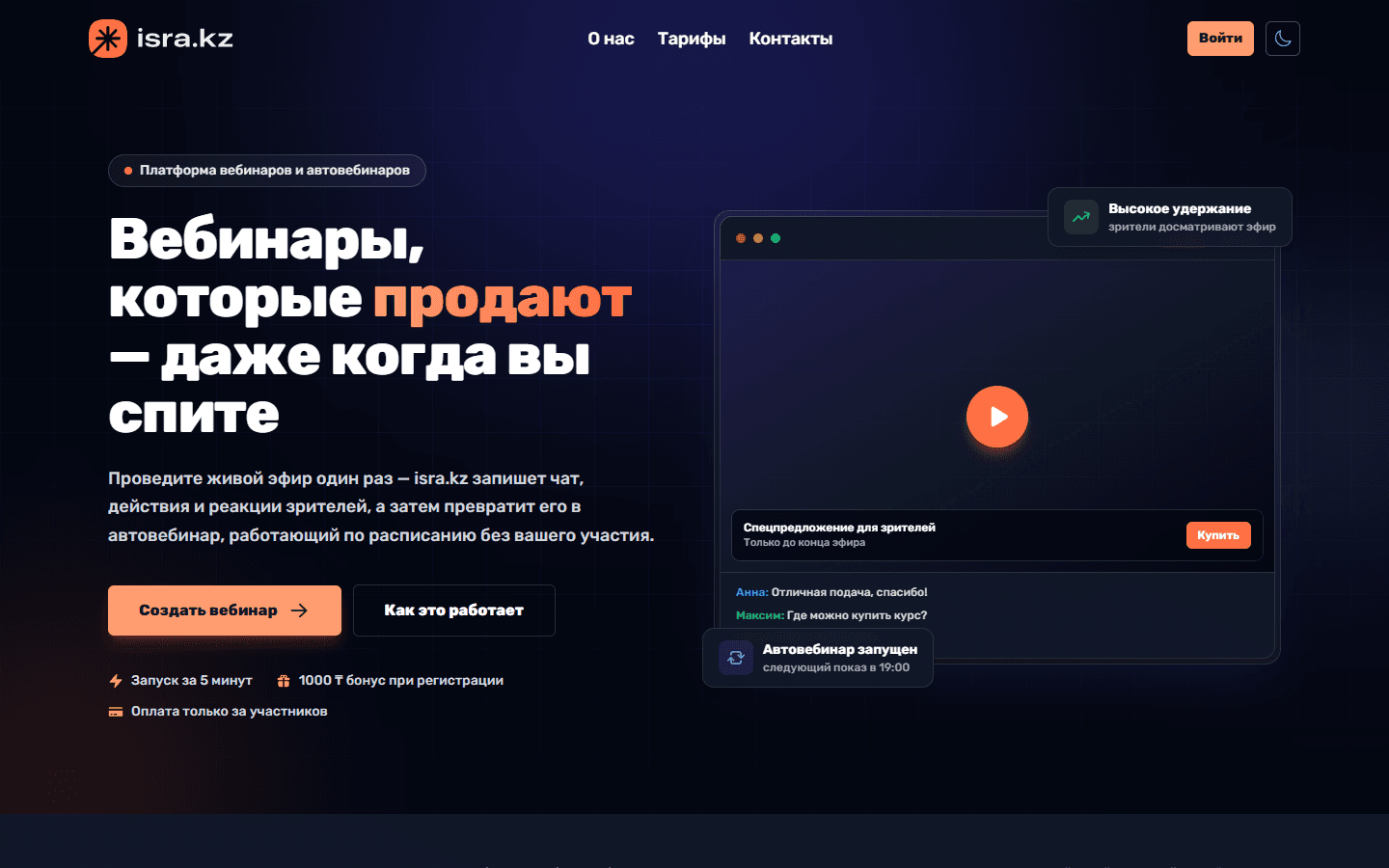
Isra
Isra (isra.kz) is a Kazakhstan platform for live webinars and auto-webinars by the 105 team. You broadcast once; the recording, chat, banners and sales buttons then replay on schedule — daily, up to five times a day, on chosen weekdays or dates. It has a moderated chat with an auto-filter, broadcast analytics, participant reports in PDF, Excel, CSV and HTML, a post-webinar report webhook and scenario import from Bizon365. The backend runs as Go microservices on PostgreSQL 16.
- Live webinars
- Scheduled auto-webinars
- Reports and webhook
Agzamov Dental ERP
Agzamov Dental ERP runs the money and operations of the Agzamov dental clinic in Almaty. A doctor bills from a phone using the tooth chart, and the cashier takes payment within a shift in a couple of taps; patient deposits, refunds and discounts above the limit need a second employee's approval. Stock with batches and expiry dates, service costing, doctors' pay under seven rule types, double-entry books and 19 management reports. Patients, doctors, price lists and appointments are pulled from Dentist Plus every 5 minutes, read-only.
- Cash desk & deposits
- Doctors' payroll
- Dentist Plus sync
ESEP
ESEP is a prototype of online accounting for Kazakhstan IT companies — LLPs and sole traders, including Astana Hub residents. Companies and employees, contracts, invoices with per-line VAT and payroll at 2026 rates already work: pension, medical contributions, income tax, social tax, social contributions and employer medical insurance, with the Astana Hub benefit applied. There is a filing calendar for forms 200, 300, 910 and others, a chart of accounts and a knowledge base. E-invoices, digital signatures and tax-return generation are still planned, and the interface says so.
- Payroll at 2026 rates
- Invoices with VAT
- Filing calendar
FamAI
FamAI is a personal CRM MVP that 105 built together with a partner team: it helps people stay in touch with family, friends and colleagues. Every contact gets a “warmth” score — days since the last conversation against the usual frequency — and a morning digest says whom to write to. The backend connects to WhatsApp; AI drafts replies in the user's own style, suggests gift ideas and transcribes voice notes. Work on the MVP stopped in January 2026, and some screens still run on demo data.
- Relationship warmth
- AI reply drafts
Kemel
Kemel is a multi-tenant ERP for holdings: data is isolated between holdings, and inside each one accounting runs by company and department with four access roles. A fast operations register, cash-flow and P&L reports, a group dashboard, a deal kanban with B2B and B2G tender pipelines and import of Bitrix24 exports, sales plans per manager and plan-vs-actual budgets that pick up payroll and payroll taxes automatically. The stack is FastAPI, MongoDB and Next.js 16.
- Holding dashboard
- Cash-flow & P&L
- B2B and tender pipelines
Auto-calls and SMS from amoCRM
An auto-dialling and SMS service for amoCRM deals that we developed from 2023. On a schedule it pulls every deal from the chosen pipeline stage, normalises Kazakh phone numbers and sends them in one request to a Zvonok call campaign or an SMSC.kz mailing. Requests to amoCRM are capped at seven per second, runs missed during downtime are not replayed after the fact, and results roll up into statistics by day and channel. The first version reacted to amoCRM webhooks and sent a report to Telegram.
- Pipeline stage → calls
- Zvonok and SMSC
- Daily statistics
amoCRM lead-source report
A lead-source report for amoCRM that shows which ads bring sales in tenge, not just enquiries. amoCRM sends an event for every new deal and stage change; the service identifies the source by UTM tag or deal tag and counts the lead → check-in → sale funnel with daily conversions. Marketers pick any period, the stages are configured to the client's pipeline, ad specialists get a UTM builder, and unrecognised tags show up as a separate row. The first version dates from 2024; in 2026 an event queue and automatic webhook registration were added.
- UTM and tags
- Lead → check-in → sale
- Sales in tenge
Next step
Discuss a pilot project
Tell us about your task — we'll come back with a data audit plan and an effect estimate within two business days.
- 1A 30-minute call: the task, your current systems, who makes the decision
- 2A review of data and processes, a staged plan with time and cost ranges
- 3A 2–4 week prototype or an 8–12 week pilot with success criteria agreed upfront
NDA from the first contact
Reply within one business day