Education · LMS

Custom LMS development: a platform for your method, not a template

We build education platforms from scratch: lessons made of blocks, interactive tasks, gamification, and cabinets for students, teachers and parents. Kazakh is the first language, not a translation from Russian.

Updated:

Short answer

Who in Kazakhstan develops custom LMS platforms?

LMS platforms in Kazakhstan are offered by international vendors of ready-made products and by local development teams. 105 ("105kz" LLP, Almaty, Astana Hub resident) builds platforms from scratch around the customer's method: lessons made of different block types, interactive tasks, gamification with leaderboards and streaks, role-based cabinets, CRM and payment links. In production are Sham Academy (an LMS for grades 1–11: 7 lesson block types, 13 task types, an interface entirely in Kazakh), Farabi Kids (14 task types, camera-based neuro-gymnastics, PWA), Kokjiek.hub (an AI English level diagnostic on the CEFR scale) and the 105test testing platform.

Scope

What an education platform is built from

We take what your teaching model needs: most often courses, motivation and cabinets.

Block
Courses and lessons
What it does
A lesson is built from blocks: text, video, comics, flashcards, audio, images, tasks; task texts can be listened to.
Where we have done it
Sham Academy: 7 lesson block types.
Block
Interactive tasks
What it does
Auto-graded tasks with game skins and sound — from crosswords to puzzles.
Where we have done it
Sham Academy: 13 task types. Farabi Kids: 14 types, including Schulte tables and timed quizzes.
Block
Motivation
What it does
Weekly leaderboards, streaks, coins, scholarships for top places, tournaments.
Where we have done it
Sham Academy: leaderboards, streaks, scholarships. Farabi Kids: Battle Cup and the Arena leaderboard. Kokjiek.hub: coins for lessons.
Block
AI diagnostic and checking
What it does
The level is determined in a chat, including by voice; a course opens to match the result; tests are graded automatically.
Where we have done it
Kokjiek.hub: the CEFR scale from A1 to C2, a free course for the level, 5 homework types.
Block
Cabinets and family
What it does
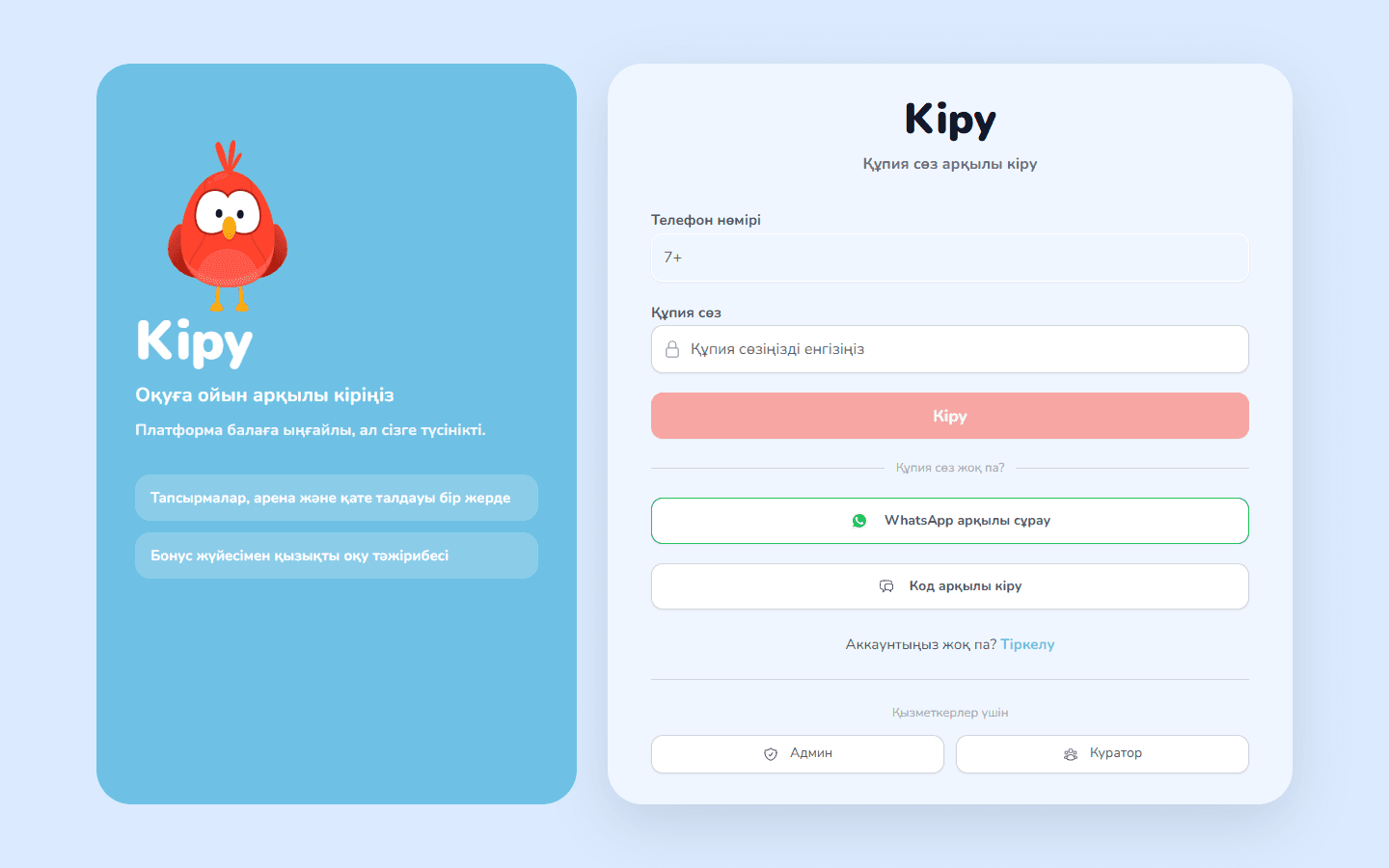
Student, parent, curator; a family account, sign-in with a WhatsApp code, a curator chat, parent reports.
Where we have done it
Sham Academy: a family account on one parent's number. Farabi Kids: daily parent reports in Telegram.
Block
Payment, CRM and analytics
What it does
Tariff payment, a link to the centre's CRM, progress reports.
Where we have done it
105test: payment via Kaspi and the Unified QR of any bank, cabinets for schools and HR. Sham Academy: a link to the school's CRM.

Choosing

A ready-made LMS or your own platform

If your teaching model is standard, a ready-made LMS is faster and cheaper — we will say so before any estimate.

Situation
A course, a test, a certificate — a standard model
What makes more sense
A ready-made LMS
Why
Faster to launch and cheaper; custom development would not pay off.
Situation
Motivation, gamification and roles are your product
What makes more sense
Your own platform
Why
Mechanics — leaderboards, streaks, scholarships, tournaments — are designed for the age and the method.
Situation
You need a full Kazakh interface and your own content
What makes more sense
Your own platform
Why
Kazakh comes first: native speakers write the texts, layouts allow for long strings, terminology is kept in a glossary.
Situation
You need your own analytics and a link to CRM and payment
What makes more sense
Your own platform or a layer on top
Why
The completion funnel, drop-off points and payment are tied to one system.
Situation
You need a phone app without app stores
What makes more sense
A PWA
Why
Farabi Kids and Kokjiek.hub run as PWAs: they install on the home screen and update without store releases.

Launch

How we launch an education project

  1. 1–2 weeks

    Method first

    The programme, the age, the length of a lesson and what already works offline.

  2. 2–4 weeks

    A prototype of one course

    One module end to end — lessons, tasks, motivation — with real students.

  3. from 6 weeks

    Platform and content

    The platform and the content migration run in parallel; methodologists work in the admin from the first weeks.

  4. ongoing

    Launch and growth

    Teacher onboarding, the completion funnel, new courses and languages.

Examples

105's education platforms in production

Each project has a case study page: what was built, on what, and what already works.

EducationGamified LMS for school students

Sham Academy

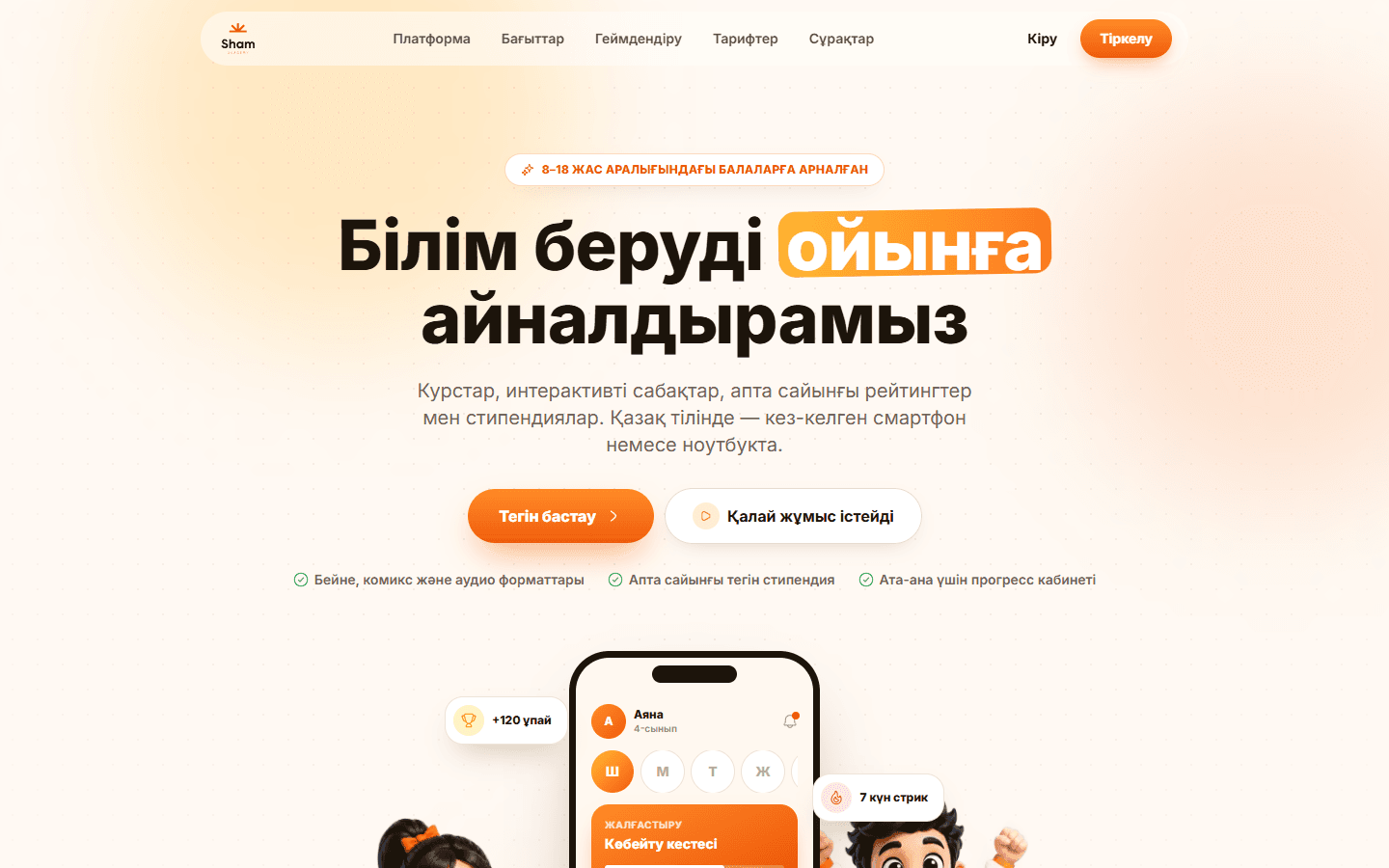
Sham Academy is a gamified LMS for school students in grades 1–11 with an interface entirely in Kazakh. Lessons are built from seven block types — text, video, comics, flashcards, audio, images and tasks; there are 13 interactive task types, some with game skins and sound, and task texts can be listened to. Weekly leaderboards, streaks and scholarships for top places; a family account on one parent's phone number, sign-in with a WhatsApp code and a link to the school's CRM.

  • 13 task types
  • Leaderboards & scholarships
  • Family account
View case
EducationKids EdTech platform

Farabi Kids

Farabi Kids (Daryndy Bala) is a Kazakh-language skills platform for children: neuro-gymnastics, speed reading, logic and calligraphy. Kids do neuro-gymnastics exercises in front of the camera and the movements are recognised right in the browser; there are 14 interactive task types, age-group diagnostics with recommendations, the weekly Battle Cup tournament, coins and cashback. Students chat with curators, parents get daily reports in Telegram, and the public diagnostic creates a deal in amoCRM straight away.

  • Camera-based exercises
  • 14 task types
  • Battle Cup and cashback
View case
EducationAI English platform

Kokjiek.hub

Kokjiek.hub (called Talpyn until June 2026) is an English learning platform with an AI level diagnostic. The diagnostic runs as a chat and accepts voice answers: AI scores them on the CEFR scale from A1 to C2, unlocks a free course at that level and passes the lead with a comment to a manager in Talpyn CRM. Five homework types with auto-graded tests, coins for lessons and sign-in by phone number with a WhatsApp code; the interface is in Kazakh and Russian and runs as a PWA.

  • AI CEFR diagnostic
  • Voice answers
  • A free course for your level
View case
EducationOnline test platform

105test

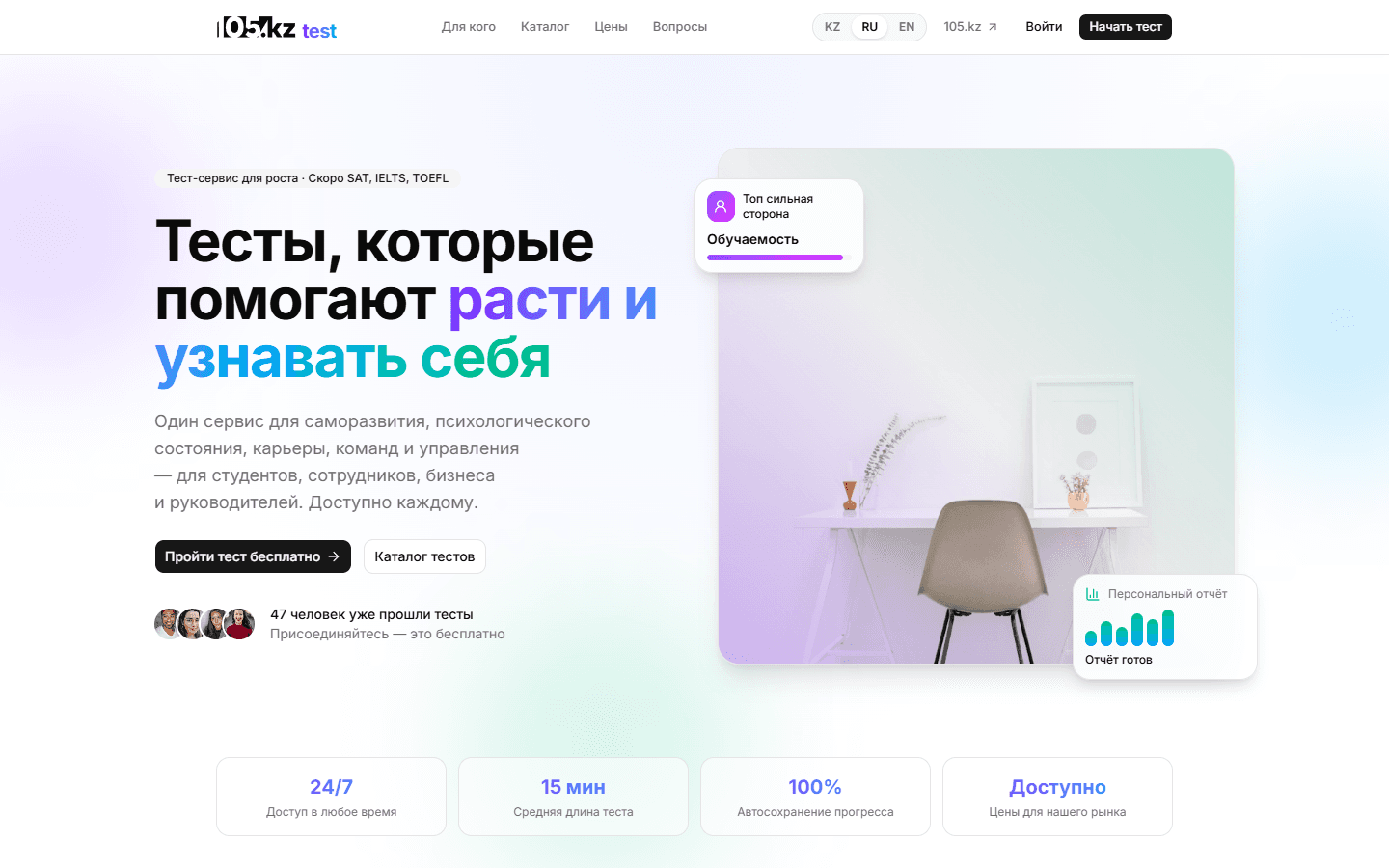
105test is 105's online testing platform for self-discovery and career choice. The Talant strengths test is built on paired statements; the comprehensive Talant Profile covers character, interests, values and career readiness in 10 age-specific forms. The report appears right after the test and a detailed AI analysis follows in 10–20 minutes; schools and companies get cabinets for group testing. Kazakh is the primary language.

  • Talant and Talant Profile
  • AI analysis of results
  • Cabinets for schools and HR
View case

FAQ

Frequently asked questions

Short, straight answers to the questions we hear most often.

How much does LMS development cost?

There is no public price list: a cabinet with a schedule and payment is one order of magnitude, an LMS with a lesson builder, gamification and analytics is another. After reviewing your method we give a range and a staged plan; a prototype of one module costs noticeably less and removes the main risks.

How long does development take?

We review the method in 1–2 weeks, build a prototype of one course with real students in 2–4 weeks, and the platform with content migration from 6 weeks. We give an exact timeline after the method review.

Is Kazakh fully supported?

Yes, and it is a matter of principle. Sham Academy and Farabi Kids are fully in Kazakh, Kokjiek.hub works in Kazakh and Russian. Native speakers write the texts, the interface is laid out for long Kazakh strings and terminology is kept in a glossary; Russian, English and Chinese are added by the same mechanism.

Do we need an app in the App Store and Google Play?

Most often, no. We build PWAs: the site installs on the home screen, works with an offline cache and updates without store releases — that is how Farabi Kids and Kokjiek.hub run. A native app makes sense for push notifications under store rules, in-app payment or heavy graphics.

Can Kaspi payment be connected?

Yes. We connect Kaspi Pay in education projects: tariff payment, access renewal and course unlocking happen automatically. On 105test payment goes through Kaspi and the Unified QR of any bank, and in Farabi Kids coins and cashback are paid out to Kaspi.

Next step

Tell us about your programme

We will look at the method, build a plan and name a range. If a ready-made LMS is cheaper, we will say so plainly.

  1. 1Method first — 1–2 weeks
  2. 2A prototype of one course — 2–4 weeks
  3. 3Platform and content — from 6 weeks

NDA from the first contact

Reply within one business day